 AMINA Bank AG
 AMINA UK
 AMINA Hong Kong

 AMINA EU
Hong Kong has the most complete stablecoin statute of any major jurisdiction. It is a dedicated Act rather than a chapter of a wider crypto law. It is enforced by the central banking authority. It reaches any Hong Kong dollar referenced token issued anywhere in the world, and it gives holders a redemption right enforceable in the issuer’s insolvency. It has produced two licensed issuers.
That sentence contains the problem this article is about. Asia regulated stablecoins earlier and more strictly than the United States or Europe. Japan classified them under the Payment Services Act in 2023. Singapore finalised its framework in August 2023. Hong Kong’s Stablecoins Ordinance took effect on 1 August 2025. The result is three rigorous regimes that between them have authorised a handful of tokens, almost all denominated in local currency, several of them subject to transfer restrictions or issuance caps, and none of them liquid at institutional size.
Meanwhile the dollar liquidity an Asian institution actually needs sits in USDT and USDC, which together account for roughly 82% of global stablecoin supply and are issued under regimes that Asian regulators do not set. Neither is authorised in Japan on the same terms as a domestic issuer. Neither is licensed under the Hong Kong Ordinance. The instrument a treasury desk in Hong Kong or Singapore can get local regulatory comfort on is not the instrument it needs, and the instrument it needs is governed elsewhere.
This gap is the practical question, and it is not the question most stablecoin analysis addresses. The market spent five years asking whether stablecoins are backed. Regulators have largely answered that. What none of them answers on its own is the question a bank’s investment committee has to sign off: can this institution acquire this token, hold it with this custodian, on this network, transfer it to that counterparty, and convert it back into fiat inside the window its treasury function requires, under the law of every jurisdiction in which it operates?
That question is not about the token. It is about the route. This article is about how the route is built in Asia, where it breaks, and what an Asian institution has to accept about the dollar regimes it cannot control.
The market Asia is regulating into
Aggregate stablecoin supply moved above $300 billion during August 2026 on DeFiLlama data, up from $269.4 billion a year earlier. The Bank for International Settlements put the market at roughly $320 billion at the end of May 2026 in its 2026 Annual Economic Report, with more than 99% of it denominated in US dollars. For a region building local-currency instruments, that last figure is the one that matters.
Figure 1: Global Stablecoin Market Capitalisation, 2020 to 2026
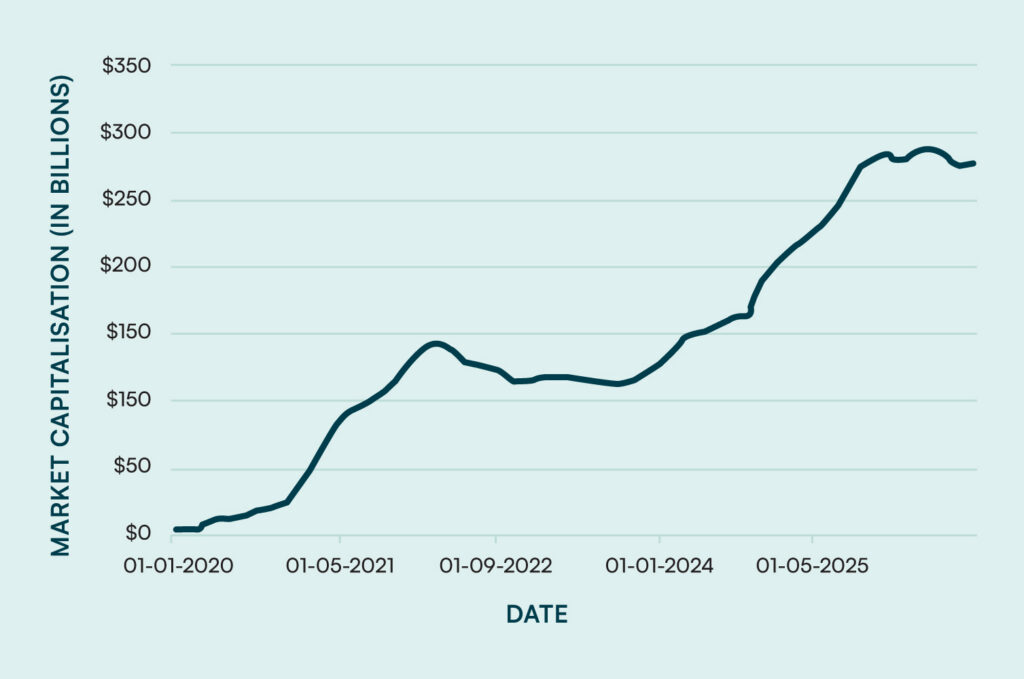
Source: DeFiLlama, AMINA Bank analysis. Data cut-off: 26 August 2026.
Three structural features of that market shape what Asian regulation can realistically achieve.
Three structural features matter more than the headline number.
1. Stablecoin Concentration
Tether and Circle together account for roughly 82% of outstanding supply, USDT at about 59% and USDC at about 23%. The regulated institutional products that dominate industry discussion sit far below that. Ripple reported $2.1 billion of RLUSD in circulation on 26 August 2026, and Paxos’ USDG was under $3.3 billion on the same date. Each is well under 1% of the market. For institutions, regulation is only part of the decision. Smaller stablecoins may offer stronger regulatory safeguards but have less liquidity, which can make large trades harder to execute.
In one jurisdiction that trade-off inverts, which is the more instructive case. Tether didn’t pursue ane-money token authorisation under MiCA, objecting among other things to the reserve deposit requirement. Licensed venues responded in sequence: Coinbase moved first in December 2024, Crypto.com followed in January 2025, and Binance and Kraken completed the process by the end of March 2025. No MiCA-licensed exchange in the EEA now offers USDT spot pairs. Kaiko data recorded USDT volume on EU venues falling more than 70% between the fourth quarter of 2024 and the second quarter of 2025 while USDC volume on the same venues nearly doubled. Inside the European regulated perimeter, the deepest token in the world is not the illiquid choice. It is not a choice at all.
2. Stablecoin supply has decoupled from the crypto price cycle
Stablecoin supply fell more than 30% in the previous bear market and has held near record levels through the 2026 drawdown. Adjusted quarterly volume across all networks surpassed $4 trillion for the first time in Q1 2026, according to a16z data. Stablecoin balances staying relatively steady during market downturns can indicate growing use for transactions beyond trading.
However, these figures should be treated with some caution. Estimates of total stablecoin transfer volume in 2025 range from about $28 trillion according to BIS to more than $62 trillion according to BCG and Allium, depending on the source and methodology. After removing bot activity, internal transfers and exchange rebalancing, estimates of actual real-world payments are much lower; in the low hundreds of billions.
The payments thesis is directionally sound and an order of magnitude smaller than headline volume implies. Institutions building capacity assumptions off gross transfer data are sizing for a market that does not exist yet.
3. Stablecoin Usage
The third feature is that none of the above may help an institution evaluate whether it can actually use the asset. That depends on a sequence of separate permissions, each with a different owner.
Figure 2: Institutional Stablecoin Lifecycle
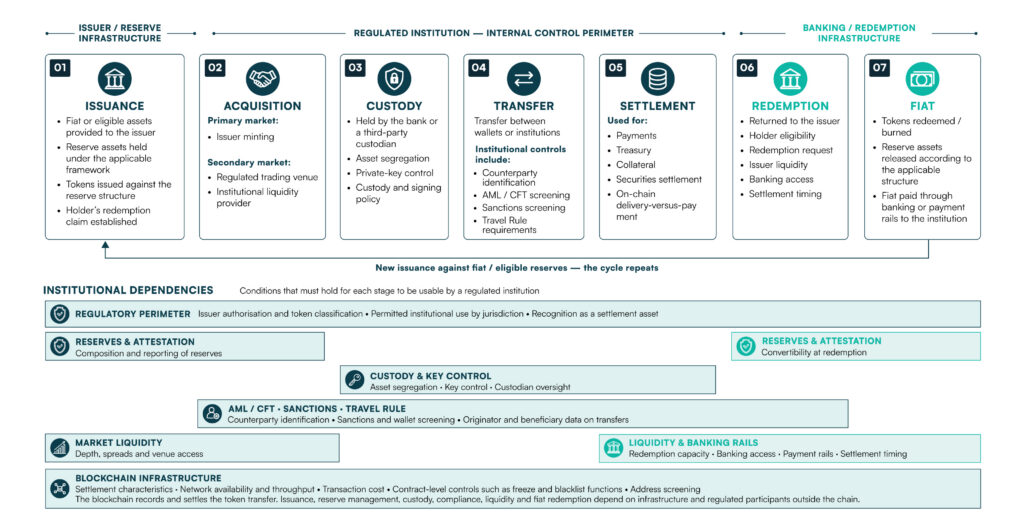
Source: AMINA Bank analysis.
Figure 2 sets out the seven stages a regulated institution passes through. Issuance determines the legal claim. Acquisition determines whether the institution faces the issuer directly or a venue, which changes its counterparty. Custody determines whether the institution can hold that specific token on that specific network. Transfer is where financial crime controls bind. Settlement is the use case. Redemption is where the claim is enforced. The fiat leg is where the banking system decides how long that takes.
In the United States and Europe, the stage that most often fails is redemption, because the fiat leg depends on correspondent banking the issuer does not control. In Hong Kong the binding stage is transfer, because licensed tokens are expected to move only between identity-verified wallets. In Japan it has been settlement, because per-transaction caps kept regulated yen tokens out of enterprise use until August 2026. An institution that imports a US or European control framework into an Asian entity will have built its controls around the wrong stage.
An institution can clear six stages and fail the seventh, and that failure is not theoretical. A stablecoin can hold its peg while a custodian suspends transfers on a network. An issuer can remain solvent while a blockchain halts. The March 2023 failure of Silicon Valley Bank is the clearest precedent: approximately $3.3 billion of Circle’s USDC reserves were temporarily inaccessible and the token traded roughly 12% below par over the following weekend, without any deficiency in the total reserve. These are distinct failure modes with distinct owners, and the price chart shows none of them until they have already happened.
Figure 3: Market Capitalisation of Leading Stablecoins, 2020 to 2026
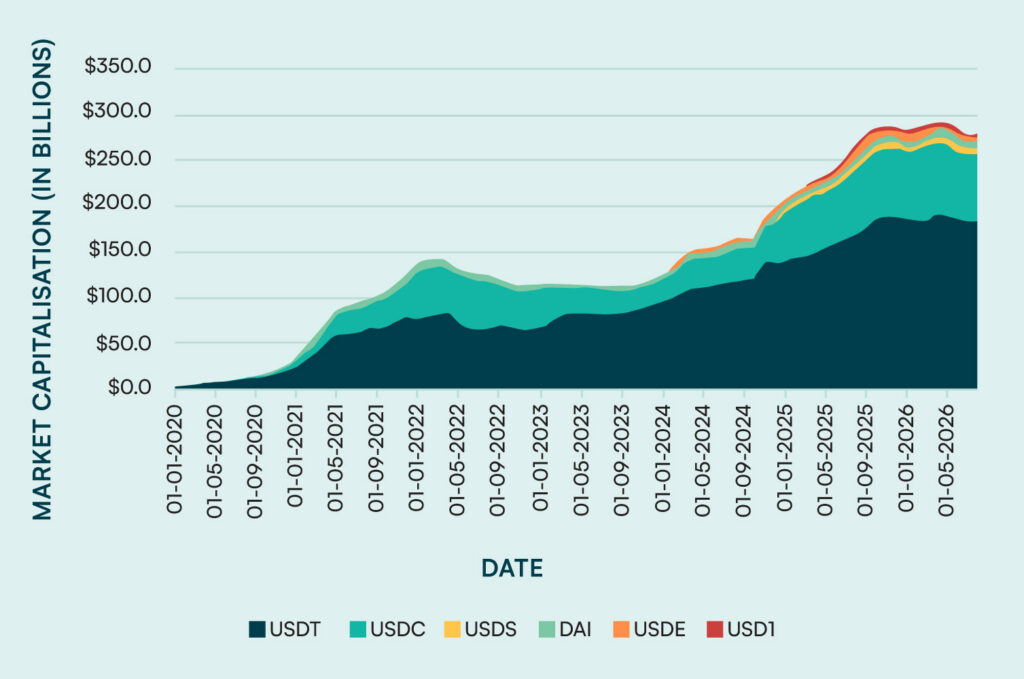
Source: DeFiLlama, AMINA Bank analysis. Data cut-off: 26 August 2026.
Three Asian regimes, three different instruments
Hong Kong, Singapore and Japan have converged on principle: full backing, high-quality liquid reserves, segregation from the issuer’s estate, enforceable redemption and financial crime controls. They have diverged on who may issue, how fast redemption must settle, what the holder actually owns in insolvency, and whether the token may move freely. Figure 4 sets those differences against the two dollar regimes an Asian institution has to interoperate with.
Figure 4: Asian and Dollar Stablecoin Regimes Compared
| Hong Kong | Singapore | Japan | United States | European Union | |
|---|---|---|---|---|---|
| Instrument | Specified fiat-referenced stablecoin under the Stablecoins Ordinance (Cap. 656) | Single-currency stablecoin (SCS) pegged to SGD or a G10 currency and issued in Singapore | Electronic payment instrument under the Payment Services Act | Payment stablecoin | E-money token (EMT) for single-currency fiat stablecoins; asset-referenced token (ART) otherwise |
| Who may issue | HKMA-licensed issuer; licence needed for any HKD-referenced token issued anywhere | MAS-licensed issuer, typically under a Major Payment Institution licence | Bank, trust company or licensed funds transfer service provider | Permitted payment stablecoin issuer: bank subsidiary, federal or state qualified issuer, or registered foreign issuer | Authorised credit institution or electronic money institution only (Art. 48) |
| Redemption standard | At par within one business day, no unreasonable fees or conditions | At par within five business days (policy finalised; implementing legislation pending) | At par; redemption terms set by issuer category | Statutory redemption at par; OCC proposal sets two business days, extendable to seven calendar days if redemptions exceed 10% of issuance in 24 hours | Unconditional right of redemption at par, at any time (Art. 49) |
| Holder claim on failure | Right to direct disposal of reserve assets pro rata and to claim shortfalls in insolvency | Segregation with approved custodians; claim against the licensed issuer | Trust-issued tokens give a direct legal claim on yield in segregated trust | Priority claim on required reserves ahead of other creditors | Safeguarded funds under Title IV; recovery and redemption plans required (Art. 55) |
| Reserve rule | 100% high-quality liquid assets, segregated and bankruptcy-remote per coin type, independently attested and audited | 100% high-quality liquid assets, monthly independent attestation, annual audit, approved custodians | 100% in segregated highly liquid assets; trust issuers may hold up to 50% in short-term JGBs | 1:1 in cash, short-term Treasuries and specified repo, plus a separate operational liquidity backstop | At least 30% of funds received in segregated credit institution deposits (Art. 54), rising to 60% for significant EMTs (Art. 58) |
| Transfer restrictions | Transfers expected between identity-verified wallets; travel rule above HK$8,000 | General AML and travel rule obligations; no protocol-level whitelisting requirement | Travel rule tightened for cross-border transfers from June 2026 | AML and sanctions rules reserved to a separate OCC and Treasury rulemaking | AML and transfer of funds regulation; no protocol-level whitelisting requirement |
| Yield to holders | No interest permitted in connection with issuance | Issuer prohibited from lending or staking reserves | Not permitted for electronic payment instruments | Prohibited; OCC proposes a rebuttable presumption against affiliate and third-party yield | Prohibited (Art. 50) |
| Status, August 2026 | Ordinance in force since 1 August 2025; two licences granted 10 April 2026; first token in restricted beta | Framework finalised August 2023; Payment Services Act amendments still in progress | PSA amendments effective 13 June 2026; pre-transaction cap removed 24 August 2026; megabank issuance targeted for FY2026 | GENIUS Act in force since 18 July 2025; FDIC and OCC proposals not final; Federal Reserve and NCUA rules outstanding | Fully applicable; EMT authorisations live; non-compliant tokens delisted from EEA venues |
Sources: Hong Kong Stablecoins Ordinance (Cap. 656) and HKMA licensing and supervision guidelines; MAS stablecoin regulatory framework; Japan Payment Services Act as amended and FSA guidance; OCC notice of proposed rulemaking under the GENIUS Act; MiCA Titles III and IV. AMINA Bank analysis.
Read the redemption row across. Hong Kong requires par redemption within one business day. Singapore allows five business days. The OCC’s US proposal sets two business days, extendable to seven calendar days where redemption requests exceed 10% of outstanding issuance in any 24-hour period. Those are different treasury instruments. A cash management desk that models them all as redeemable at par has mispriced its own liquidity, and the stress-case extension is the number that matters, because it applies precisely when the money is needed.
Read the holder claim row and the difference is sharper still. Under the Hong Kong Ordinance a holder has the right to direct disposal of reserve assets on a pro rata basis and to claim any shortfall in the issuer’s insolvency. Under the Japanese trust structure the holder has a direct legal claim on yen held in a segregated trust account. Under MiCA the holder has an unconditional redemption right against an authorised issuer. These are not the same security, and a collateral desk that treats them as equivalent has mispriced the recovery.
Hong Kong: the most complete framework, but few usable assets
Hong Kong’s Stablecoins Ordinance (Cap. 656) took effect on 1 August 2025 and is one of the most comprehensive stablecoin regimes. Any person issuing a fiat-referenced stablecoin in Hong Kong needs an HKMA licence, as does anyone issuing an HKD-referenced stablecoin anywhere in the world. This extraterritorial reach over HKD is unusual.
The licensing requirements are deliberately bank-grade. Non-bank issuers need HK$25 million in paid-up capital and HK$3 million in liquid capital, while reserves must be fully backed, segregated and bankruptcy-remote. Stablecoins must be redeemable at par within one business day, with independent reserve attestation and audit.
The HKMA received 36 applications but granted only two licenses on 10 April 2026: one to Anchorpoint Financial, backed by Standard Chartered, HKT and Animoca Brands, and one to HSBC. Both focus on HKD stablecoins, implying an approval rate of only about 6%. HKMA granted the first two stablecoin issuer licences on 10 April 2026
The market is still very small. Anchorpoint began restricted beta access for HKDAP in August 2026, targeting institutions and professional investors, while HSBC has indicated a second-half 2026 launch. For now, Hong Kong effectively has two licensed issuers and one live token in restricted beta, rather than a mature stablecoin market. Asia Times reported on Anchorpoint’s HKDAP beta launch
Operationally, Hong Kong’s AML framework is also significant. Licensed stablecoins are expected to move between identity-verified wallets, with Travel Rule requirements above HK$8,000. This creates a permissioned, whitelist-based transfer model that may suit regulated institutions but differs from the open-transfer model used by most existing crypto infrastructure.
Hong Kong’s potential scale is also constrained by mainland China’s policy. Ant Group and JD.com dropped planned offshore RMB stablecoins after intervention from Chinese authorities, while 2026 policy has continued to restrict private RMB-pegged stablecoins. As a result, Hong Kong’s stablecoin market is likely to remain HKD-focused, bank-led and institution-heavy, at least while the current policy holds. Forbes reported on the cancellation of planned yuan stablecoins
Singapore: a narrow label doing international work
Singapore’s framework is deliberately narrower. MAS finalised its stablecoin regulatory framework on 15 August 2023. It applies to Singapore-dollar or G10 currency-backed stablecoins issued in Singapore. The framework requires issuers to hold reserves equal to 100% of the stablecoins in circulation, with monthly independent checks, an annual audit, and reserves held separately with approved custodians.
Redemption is at par within five business days. Issuers must hold minimum base capital and liquid assets sufficient for an orderly wind-down, and are barred from lending, staking or unrelated commercial activity, a ring-fence adopted in place of a full risk-based capital regime. Non-bank issuers with less than S$5 million in circulation fall outside the requirements. Only issuers meeting every condition may apply to have their stablecoins labelled MAS-regulated stablecoins. Stablecoins issued outside Singapore remain under the general digital payment token regime.
One qualification matters for anyone relying on that five-day window in a policy document. The framework was finalised as policy in 2023, but the amendments to the Payment Services Act that give it legal effect remain in progress. Until they are enacted, the redemption period is a supervisory expectation that issuers describe themselves as substantively meeting, not yet a statutory entitlement enforceable by a holder.
The narrowness is otherwise the feature. MAS is not attempting to regulate the global stablecoin market. It is making one category unambiguous, and issuers have used that clarity as an international base. Paxos structured USDG from Singapore before extending it into the EU, and states that USDG remains redeemable at par by all holders wherever they redeem, in accordance with the requirements of both MAS and the EU.
That sentence contains the whole cross-border problem. Par redemption is preserved commercially. The legal counterparty is not.
Japan: the strongest holder claim in the region
Japan moved earliest and has the most developed institutional stack, though it took until 2026 to become usable at enterprise scale. Amendments to the Payment Services Act effective June 2023 classified fiat-referenced stablecoins as electronic payment instruments and restricted issuance to three categories of licensed entity: banks, trust companies and licensed funds transfer service providers. Reserves must equal 100% of outstanding value in segregated, highly liquid assets. Further PSA amendments took operational effect on 13 June 2026, expanding registration requirements, tightening travel rule obligations on cross-border transfers, and clarifying the Financial Services Agency’s posture toward foreign platforms soliciting Japanese users. From 1 June 2026 foreign trust-type stablecoins may operate in Japan as electronic payment instruments, subject to FSA licensing, collateral management and audit standards.
The trust structure is what makes Japan analytically interesting for an institutional holder. Where a yen stablecoin is issued through a trust bank, the holder has a direct legal claim on yen held in a segregated trust account rather than a contractual redemption right against an operating company. That is a stronger protection than any other regime in this comparison provides, and it is the reason the trust-issued tokens rather than the funds-transfer tokens are the ones institutions should be looking at.
The market reflects that hierarchy. JPYC launched in October 2025 as the first fully regulated yen stablecoin under a second-category funds transfer license, backed by yen deposits and Japanese government bonds, but constrained by a per-user cap that kept it in retail and micropayment use. JPYSC, issued by SBI Shinsei Trust Bank and developed with Startale Group, launched in June 2026 as the first trust bank-backed yen stablecoin and raised roughly $70 million on its first day. MUFG, Sumitomo Mitsui and Mizuho signed a joint agreement in June 2026 to co-issue a yen stablecoin through a trust structure on the Progmat platform, targeting roughly one trillion yen of business-to-business issuance by 2028 and live transactions within the fiscal year ending March 2027.
Two developments in August 2026 changed the practical position. The FSA removed the one million yen per-transaction cap that had confined second-category providers to micropayments since 2023, and established a dedicated Cryptocurrency and Stablecoin Division with three specialist offices. Regulated yen tokens became usable at enterprise size only in the last month, which is worth remembering when reading adoption figures that predate it.
Japan also shows what a strict domestic regime does to foreign dollar tokens. USDT remains largely unavailable on licensed Japanese platforms. USDC has a regulated pathway through SBI VC Trade following its partnership with Circle, but access is narrower than in most markets. An institution operating in Japan therefore faces the same structural mismatch as one in Hong Kong: strong local instruments in the local currency, and constrained access to the dollar liquidity that cross-border business actually requires.
Korea and the Mainland: the two positions that decide the region's next phase
Neither Korea nor mainland China has a live stablecoin framework, and both matter more to the regional outlook than the jurisdictions that do.
South Korea has been trying to legislate since 2025 and has not resolved the central question of who may issue. The Bank of Korea has argued that issuance should be led by licensed commercial banks on financial stability grounds, while the Financial Services Commission has pushed for broader participation by fintech and technology firms. Proposals have circulated for a bank-controlled consortium structure with a minimum bank shareholding, and have been criticised in the National Assembly as protecting incumbents. A joint roadmap published on 19 July 2026 by the Ministry of Economy and Finance with the FSC, the Bank of Korea, the Financial Supervisory Service, the Korea Exchange and the Korea Securities Depository linked won stablecoins to foreign exchange reform and tokenised government bonds, and the FSC has since said it is consolidating around ten pending bills into a single government-backed Digital Asset Framework Act, with passage sought before the end of 2026. A consortium of major commercial banks is developing a shared won-pegged token in anticipation. Until the ownership question is settled, none of it is bankable.
Mainland China has settled its question in the opposite direction. The reported February 2026 notice bars renminbi-pegged stablecoin issuance without prior approval, onshore and offshore, and official commentary has consistently framed private issuance of currency-like instruments as a challenge to monetary sovereignty and to the digital renminbi. For institutions, the operative point is not the policy rationale but its durability: plans that depend on an offshore renminbi stablecoin emerging through Hong Kong should be treated as contingent on a reversal that Beijing has now declined several times.
The dollar regimes an Asian institution has to interoperate with
Because the liquidity is dollar-denominated, an Asian institution has to understand three frameworks it has no influence over. What follows is the operationally relevant summary rather than a survey.
The United States created a federal category, the permitted payment stablecoin issuer, when the GENIUS Act was signed on 18 July 2025, but the rules are not final. The FDIC issued the first agency-specific proposal in December 2025. The OCC followed with the comprehensive one: its notice of proposed rulemaking was issued on 25 February 2026 and published in the Federal Register on 2 March, establishing a new 12 CFR Part 15 covering applications, permitted activities, reserves, redemption, capital, risk management and custody. The OCC’s bulletin confirms that anti-money laundering and sanctions requirements are reserved for a separate rulemaking with the Treasury, and the Federal Reserve and NCUA have issued nothing. The proposal asks more than 200 questions for public comment. The operative date is the earlier of 18 January 2027 or 120 days after final rules. Integrations built against proposed rules carry rework risk that should be budgeted rather than assumed away.
The European Union is where classification decides everything, and where most analysis goes wrong. A stablecoin referencing a single official currency is an electronic money token under Title IV of MiCA, not an asset-referenced token under Title III, and the two produce materially different insolvency analysis for a bank lending against the collateral. Under Article 48 an EMT may only be issued by an authorised credit institution or electronic money institution, which excludes the trust company structures common in the United States. Article 49 grants an unconditional redemption right at par at any time, Article 50 prohibits interest, and Article 54 requires at least 30% of funds received to be held in separate credit institution accounts, rising to 60% under Article 58 for tokens designated significant, at which point supervision transfers to the European Banking Authority.
The practical consequence for an Asian group with European entities is entity substitution. USDC in the EEA is issued by Circle Internet Financial Europe SAS, an electronic money institution authorised by the French Autorité de contrôle prudentiel et de résolution, while outside the EEA the issuer is Circle Internet Financial, LLC. Société Générale-FORGE reached the same compliance through the credit institution channel instead. Paxos established a Finnish issuer. One commercial token, several legal persons, and a redemption claim that runs against whichever entity issued the particular holding.
The United Kingdom is the one regime where treatment escalates with success, which matters for anyone integrating early. The FCA published final rules on 30 June 2026 and will authorise issuers of qualifying stablecoins from 25 October 2027, with applications open from 30 September 2026 and firms advised to apply by February 2027. Where HM Treasury recognises an arrangement as systemic, the Bank of England joins as co-regulator: its policy statement and draft Code of Practice of 22 June 2026 replaced proposed per-user holding limits with a temporary £40 billion issuance guardrail per systemic coin and set backing assets at up to 70% short-term sterling government debt with the remaining 30% in unremunerated central bank deposits. The joint approach document of 30 June defines timely convertibility as as soon as possible, at a minimum by end of day and ideally intraday. No stablecoin has yet been recognised as systemic, so an institution integrating a UK token today is integrating an asset whose supervisor and reserve rules will change if it succeeds.
Switzerland is worth a line for groups with a Swiss entity. FINMA’s Guidance 06/2024 treats a fiat-pegged token with a fixed redemption value as functionally equivalent to a public deposit, requiring a banking or fintech licence or an irrevocable bank guarantee. The Federal Council’s consultation on the Financial Institutions Act closed on 6 February 2026 and proposes new payment institution and crypto institution categories, removing the previous CHF 100 million deposit cap. Published commentary differs on whether the new issuance authority is exclusive to the payment institution category or additional to existing routes, and the framework is not expected to be in force before 2027.
The blockchain is a second fragmentation, and it does not match the first
Regulatory approval establishes that a token is permissible. It says nothing about whether it can move.
Figure 5: Stablecoin Supply by Blockchain, August 2026
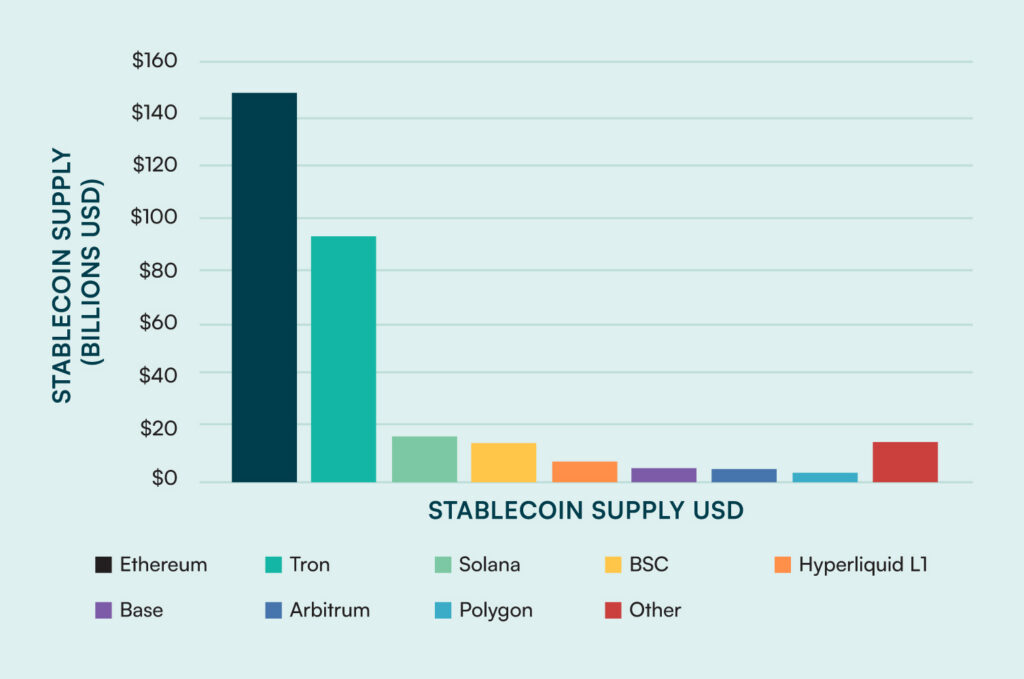
Source: DeFiLlama, AMINA Bank analysis. Data cut-off: 26 August 2026.
Supply is concentrated. Ethereum carries roughly half of all stablecoin supply and Tron close to 30%, together about 80% of the market, on DeFiLlama and Artemis data through 2026. Solana, BNB Chain, Hyperliquid, Base, Arbitrum and Polygon each hold low single-digit shares, and the entire remaining set of networks together holds less than Tron alone.
Activity is not concentrated in the same places, and the Asian pattern differs from the global one. Solana overtook both Ethereum and Tron in adjusted monthly stablecoin transaction volume during the first quarter of 2026, reaching roughly $650 billion in February against a total of about $1.8 trillion across all chains on Allium data cited by Grayscale. Tron nonetheless continues to carry the majority of genuine real-economy payment flow, concentrated in dollar transfers across emerging Asia, though its share has fallen as regulated volume moved onto Ethereum, Solana, BNB Chain and Polygon. An institution serving Asian payment corridors and one serving Asian custody demand will reach different network conclusions from the same data.
This is why the operative unit is an asset-network pair rather than an asset. A bank may approve a token on Ethereum through its institutional custodian and decline the same token on a network its custodian does not support or its analytics provider does not screen. It is also why Asian permissioned tokens sit awkwardly in existing frameworks: a network approval that assumes open transfer does not describe an asset whose transfers are gated at the contract level.
Native issuance and bridged representation are not the same credit either. Against the native token the institution holds a direct claim on the issuer. Against a bridged representation it also holds exposure to bridge smart contracts and their operators, and a bridge failure can impair the position while the issuer remains solvent and fully reserved. The BIS identified precisely this fragmentation, the same token living on separate ledgers with bridges between them, as the reason stablecoins fail its interoperability test. The two should be approved separately, and the approval record should state which one the institution holds.
Figure 6: The Institutional Stablecoin Stack
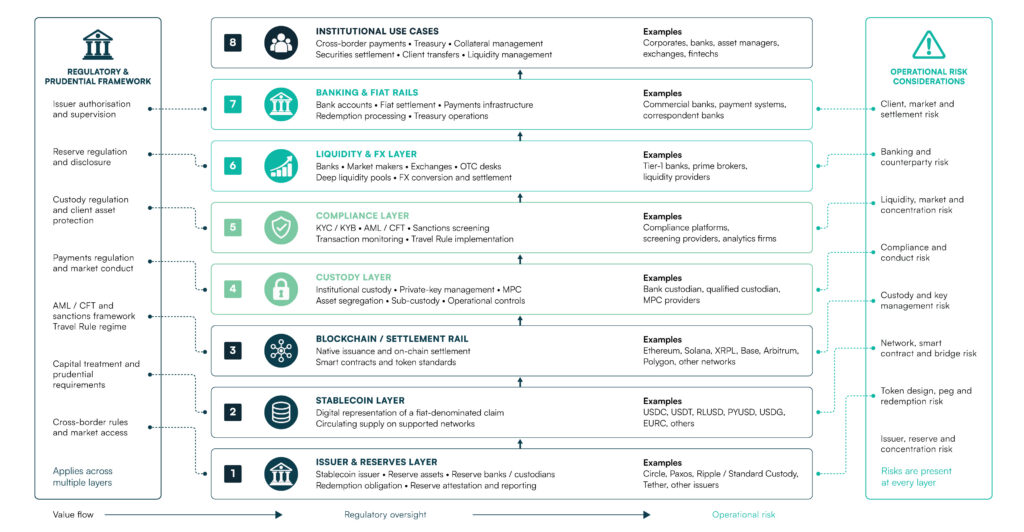
Source: AMINA Bank analysis.
Figure 6 shows why regulation cannot be assessed at the issuer alone. Prudential rules bind the issuer and reserve layer. Custody rules bind key control and client asset protection. AML, sanctions and travel rule obligations bind transfers, which in Hong Kong reach into the token contract itself. Market conduct rules bind liquidity venues. Payments regulation binds settlement. A stablecoin due diligence file is therefore a composite of asset, counterparty, custody, payments and technology diligence, and no single team inside a bank owns all five. Where an institution finds it difficult to name the owner of a given layer, that is usually where the control gap is.
Where the economics went, and why that is now a supervisory question
Every regime in this comparison reached the same conclusion: a payment stablecoin must not compete with a bank deposit. The Hong Kong Ordinance permits no interest in connection with issuance. MAS prohibits issuers from lending or staking reserves. MiCA prohibits interest or any benefit linked to holding period. The GENIUS Act prohibits permitted issuers from paying yield. The Bank of England restricts remuneration under its draft systemic Code.
Reserve income did not disappear. On more than $300 billion of supply backed largely by short-term government paper, it is substantial. Since it cannot legally flow to the holder, it flows to whoever controls distribution, and the scale of that transfer is larger than most commentary allows.
The Circle and Coinbase arrangement is the best documented case because it appears in public filings. Under a collaboration agreement effective 18 August 2023, Coinbase receives 100% of the reserve income generated on USDC held on its own platform and 50% of residual reserve income on USDC circulating elsewhere. Circle paid Coinbase approximately $908 million in 2024, around 54% of its revenue that year, and reserve income accounted for $2.637 billion of Circle’s $2.747 billion total revenue in 2025. Circle confirmed on its second-quarter 2026 earnings call that the agreement had renewed on unchanged terms.
The Global Dollar Network makes the same logic explicit as a design principle rather than a legacy arrangement, with partners able to receive up to 100% of the returns generated by USDG-backed assets held on their platforms. Tether, by contrast, retains reserve income, which funds one of the most profitable balance sheets in the sector and is a large part of why it declined MiCA authorisation. The Asian bank-issued tokens sit outside this pattern entirely: HSBC and Anchorpoint are not competing for distribution partners on reserve economics, they are issuing into their own customer bases.
This reframes stablecoin competition. If issuers cannot buy holders with yield, they compete on the quality of the rail and on the economics they can offer distributors. Float becomes a lagging indicator. The leading indicators are how many regulated custodians support the exact token and network, how many jurisdictions recognise the issuing entity, how quickly redemption clears to a named bank, and how much of the reserve economics the issuer will share to win a distribution partner.
It also raises a supervisory question that has moved recently. A prohibition on issuer-to-holder interest combined with unrestricted issuer-to-distributor payment moves the economics one step outside the regulated perimeter rather than removing them. The OCC has proposed to close that gap directly, establishing a rebuttable presumption that an issuer violates the yield prohibition where it has an arrangement with an affiliate or related third party to pay interest or yield to holders. Related third party is defined broadly enough to capture any person paying interest to holders as a service, and any white-label distributor on whose behalf an issuer mints. Asian distributors of US-issued tokens are within scope of that logic even though they are outside the OCC’s jurisdiction, because the constraint binds the issuer’s ability to pay them. Institutions receiving distribution economics should be able to evidence that any client-facing reward is disclosed, risk-qualified and not presented as a deposit return, and should model the revenue on the assumption that the terms may change.
What an institutional approval file has to contain
A conventional digital asset list records ticker, issuer and custody status. That is insufficient once the same commercial token is issued by different entities, on different networks, under different redemption arrangements, with different transfer permissions.
Figure 7: Institutional Stablecoin Due-Diligence Framework
| Area | What must be established | Failure mode if skipped |
|---|---|---|
| Issuing entity | The exact legal entity, its licence and regulator, and which of the issuer’s entities faces this institution | Redemption claim asserted against the wrong counterparty |
| Holder claim | Whether the token is an EMT, ART, payment stablecoin or SCS, and what that classification confers | Insolvency treatment misjudged, collateral value overstated |
| Reserve structure | Composition, liquidity, segregation, named reserve custodians, attestation frequency and auditor | Concentration risk at a reserve bank invisible until it matters |
| Redemption mechanics | Eligibility, minimum size, fees, settlement window in normal and stressed conditions, and the named fiat leg | Liquidity mismodelled by days |
| Custody | Supported network, exact token contract address, key management model, segregation and sub-custody chain | Institution approves a token its custodian cannot hold |
| Network | Availability, finality, congestion behaviour, contract-level freeze and blacklist controls, and outage precedent | Valid asset becomes untransferable |
| Native versus bridged | Whether the holding is issuer-native or a bridged representation, and which bridge | Bridge failure impairs a position the issuer never defaulted on |
| Financial crime | Screening coverage for the network, travel rule capability, and whether counterparty wallets meet receiving-side rules | Transfer rejected at the receiving institution |
| Counterparties and venues | Permitted recipients, market makers and OTC desks, and depth at institutional size | Exit available only at retail size |
| Cross-border | Recognition and restrictions in every jurisdiction in which the institution operates | Compliant transfer in one entity, breach in another |
| Failure and recovery | Contingency for issuer, reserve bank, custodian, network and bridge, and the alternative redemption route | No playbook during the event |
Source: AMINA Bank analysis, based on the regulatory frameworks and issuer documentation cited in this article.
Run a regional book through this table and the output is not a list of approvals. It is a matrix. A Hong Kong dollar token approved for Hong Kong entities on a permissioned basis with whitelisted counterparties. USDG approved via Paxos Digital Singapore for Asian entities and assessed separately via Paxos Issuance Europe for European ones. USDC approved via the US issuer in Asia and via Circle Internet Financial Europe in the EEA. USDT available in most of Asia, absent from licensed Japanese and European venues. A yen token whose holder claim depends on whether the issuer is a trust bank or a funds transfer provider. That is more work than adding tickers to a list. It is also an accurate description of the exposure.
The competitive question in Asia
The largest stablecoins hold an advantage that is difficult to attack directly, because liquidity attracts liquidity. Institutional adoption in Asia introduces a second axis of competition that market capitalisation rankings do not capture, and the regional evidence shows that regulatory eligibility can override the liquidity advantage outright inside a given perimeter.
A stablecoin built for institutional use in this region has to satisfy several constituencies at once. It needs an issuing structure a legal team can map to a licence in each entity’s jurisdiction. It needs reserves a risk team can monitor and a named custodian it recognises. It needs custody support from institutions the bank already uses. It needs depth at institutional transaction sizes rather than retail ones. It needs compliance infrastructure that interoperates with the receiving institution’s, which in Hong Kong means wallet-level identity verification. It needs banking relationships that deliver the fiat leg inside a treasury-relevant window.
The issuers take visibly different routes. Circle has pursued authorisation in each perimeter it wants access to, accepting multiple licences and a distribution arrangement that transfers roughly half its reserve income. Tether has optimised for liquidity and retained economics, accepting exclusion from European and Japanese licensed venues as the price. Paxos has built regulated issuance in Singapore and the EU with a distribution network that shares reserve economics deliberately. Japanese trust banks are building the strongest holder claim in the region and the smallest addressable market. Hong Kong’s licensees start from prudential credibility and constrained transferability. None has produced a token that is portable across these regimes without entity-level substitution, because the regimes do not permit it.
That constraint will shape the next phase. The leading institutional stablecoin in Asia is unlikely to be the one with the largest float. It is more likely to be the one that requires the fewest institutions to build a bespoke control framework around it.
Conclusion
Asia has demonstrated that a stablecoin regime can be strict, complete and enforceable. Hong Kong wrote the redemption right into primary legislation and made it survive insolvency. Japan built a trust structure that gives holders a direct claim on segregated fiat. Singapore made one category unambiguous and exportable. On the quality of the legal instrument, these are ahead of anything the United States or the United Kingdom has yet brought into force.
What Asia has not demonstrated is that strict regimes produce usable assets at institutional scale. Two licensed issuers in Hong Kong, one token in restricted beta, a Singapore framework awaiting implementing legislation, Japanese enterprise-scale issuance unlocked only in the last month, Korea unresolved, and the mainland closed. The dollar liquidity the region’s cross-border business runs on remains issued elsewhere under rules the region does not write.
Three conclusions follow for institutions building this capability now.
The unit of approval is the route, not the asset. The correct object is the combination of issuing entity, token classification, contract address, network, custodian, transfer permissions, screening coverage and fiat settlement path. Approving a ticker approves almost nothing, and in Hong Kong it does not even establish that a transfer can be initiated.
Redemption and the holder claim are treasury and credit parameters, not legal formalities. One business day in Hong Kong, five in Singapore, two extendable to seven under the OCC proposal, and end of day under the UK systemic regime are different instruments. A pro rata claim on segregated reserves, a direct trust claim on segregated yen and a contractual redemption right against an operating company are different securities. Both sets should be modelled separately and stressed at the adverse end.
The regional perimeter is still forming, and the binding constraints are political as much as prudential. Singapore’s implementing legislation is pending. Korea’s issuer question is unresolved. Beijing’s position on renminbi-referenced tokens removes the single development that would have given Hong Kong scale. US rules are proposed rather than final, and the OCC’s position on distribution economics would reshape the commercial model if adopted as drafted. Integrations built today should assume revision, and contracts should be written to permit it.
For AMINA these are operating questions rather than analytical ones. AMINA (Hong Kong) Limited holds Type 1, Type 4 and Type 9 licences from the SFC, AMINA Bank AG is a FINMA-regulated Swiss bank, and AMINA (Austria) AG holds a MiCA crypto-asset service provider licence from the Austrian FMA. Holding one commercial token across several regulatory regimes is a condition the institution operates under, not a scenario it models. This article reflects that vantage point and should be read with it in mind.
The market has established that a digital dollar can move. What determines the next phase in Asia is whether the instruments the region has authorised can carry institutional volume, or whether the region ends up supervising local-currency tokens while its balance sheets settle in dollars issued somewhere else.
Frequently asked questions
Q. Which Asian jurisdiction has the strictest stablecoin regime?
Hong Kong has the most complete statute. The Stablecoins Ordinance requires a licence for any fiat-referenced stablecoin issued in Hong Kong and any Hong Kong dollar referenced token issued anywhere, sets minimum paid-up capital of HK$25 million with liquid capital and twelve months of operating expenses on top, requires par redemption within one business day, and gives holders a pro rata claim on reserve assets that survives the issuer’s insolvency. Japan arguably provides the strongest holder protection through its trust structure, which gives a direct legal claim on segregated yen rather than a contractual claim on an issuer.
Q. Why has Hong Kong licensed so few stablecoin issuers?
The HKMA assessed 36 applications and granted two licenses on 10 April 2026, to Anchorpoint Financial and HSBC. Two factors drove that. The regulator signalled from the outset that the first batch would be deliberately small and prioritised reserve quality, risk management and financial crime controls, which favours bank-led applicants. Separately, several of the largest potential applicants withdrew after mainland regulators intervened against renminbi-referenced stablecoin plans routed through Hong Kong.
Q. Can an institution in Asia simply use USDT or USDC instead?
It depends on the entity and the jurisdiction. USDT is widely available across most of Asia but is absent from licensed Japanese platforms and from MiCA-licensed venues in the European Economic Area, so a group with Japanese or European entities cannot apply one policy across the book. USDC has a regulated pathway in Japan through SBI VC Trade and is issued in the EEA by a separate French entity from the US issuer. The practical answer is that the same ticker requires different approvals, and sometimes different issuers, in each entity’s jurisdiction.
Q. What does a permissioned-transfer stablecoin change operationally?
Hong Kong’s licensed stablecoins are expected to move only between identity-verified wallets, with travel rule obligations above HK$8,000, which in practice means transfers are restricted to whitelisted addresses. Counterparty screening therefore happens before the transfer rather than in downstream monitoring. That is arguably better control, but it breaks assumptions built into most custody, treasury and reconciliation systems, which assume a transfer can always be initiated and a position can always be moved to a venue.
Q. Is a stablecoin regulated in one jurisdiction automatically usable in another?
No. Authorisation in one jurisdiction does not establish eligibility in another. The same commercial token can be issued by different legal entities under different supervisors, as USDG is through Paxos Digital Singapore in Singapore and Paxos Issuance Europe Oy in the European Union, and as USDC is through Circle Internet Financial, LLC and Circle Internet Financial Europe SAS. The institution’s redemption claim runs against whichever entity issued its particular holding.
Q. Can institutions earn a return on stablecoin holdings?
Not from the issuer. The Hong Kong Ordinance permits no interest in connection with issuance, MAS prohibits lending or staking of reserves, and MiCA and the GENIUS Act prohibit interest to holders. Reserve income instead flows to distribution partners, the largest documented example being Circle’s agreement with Coinbase. That route is now under scrutiny: the OCC’s proposed rule would create a rebuttable presumption against arrangements in which an affiliate or related third party pays yield to holders on an issuer’s behalf. Any client-facing rewards depend on the specific arrangement, are not guaranteed, may change if that rule is finalised as drafted, and carry issuer, counterparty, custody and operational risk.
Disclaimer – Research and Educational Content (Hong Kong)
This document has been prepared by AMINA (Hong Kong) Limited (“AMINA HK”). AMINA HK is a Type 1 (Dealing in Securities), Type 4 (Advising in Securities) and Type 9 (Asset Management) licensed corporation regulated by the Securities and Futures Commission (“SFC”).
WARNING: This document and its contents have not been reviewed by the SFC or any other regulatory authority in Hong Kong. You are advised to exercise caution in relation to the information provided. If you are in any doubt about any of the contents of this document, you should obtain independent professional advice.
This document is published solely for informational and educational purposes; it does not constitute an advertisement, a personal recommendation, nor a solicitation or an offer to buy or sell any financial investment, virtual asset or to participate in any particular investment strategy. This document is for publication only on the AMINA HK website, blog, and AMINA HK social media accounts as permitted by applicable law. It is not directed to, or intended for distribution to or use by, any person or entity who is a citizen or resident of or located in any locality, state, country or other jurisdiction where such distribution, publication, availability or use would be contrary to law or regulation or would subject AMINA HK to any registration or licensing requirement within such jurisdiction.
Research will initiate, update and cease coverage solely at the discretion of AMINA HK. This document is based on various sources, incl. AMINA HK’s internal data. In preparing this document, AMINA HK may have made limited use of artificial intelligence–enabled tools to assist with research, summarisation, and drafting, with all content subject to human review and validation.
No representation or warranty, either express or implied, is provided in relation to the accuracy, completeness or reliability of the information contained in this document, except with respect to information concerning AMINA HK. The information is not intended to be a complete statement or summary of the subjects alluded to in the document, whereas general information, financial investments, virtual assets, markets or developments. AMINA HK does not undertake to update or keep current information. Any statements contained in this document attributed to a third party represent AMINA HK’s interpretation of the data, information and/or opinions provided by that third party either publicly or through a subscription service, and such use and interpretation have not been reviewed by the third party.
Any formulas, equations, or prices stated in this document are for informational or explanatory purposes only and do not represent valuations for individual investments. There is no representation that any transaction can or could have been affected at those formulas, equations, or prices, and any formula(s), equation(s), or price(s) do not necessarily reflect AMINA HK’s internal books and records or theoretical model-based valuations and may be based on certain assumptions. Different assumptions by AMINA HK or any other source may yield substantially different results.
Nothing in this document constitutes a representation that any investment strategy or investment is suitable or appropriate to an investor’s individual circumstances. Investments involve risks, including the possible loss of the principal amount invested. Virtual assets and tokenized assets are highlight volatile, subject to complex regulatory environments, and carry significant market, liquidity and cybersecurity risks. Investors should exercise prudence and their own independent judgment in making their investment decisions. Financial investments and virtual asset services described in the document may not be eligible for sale in all jurisdictions or to certain categories of investors. Certain services and products are subject to legal restrictions and cannot be offered on an unrestricted basis to certain investors. Recipients are therefore asked to consult the restrictions relating to investments, products or services for further information. Furthermore, recipients may consult their legal/tax advisors should they require any clarifications.
At any time, investment decisions (including, among others, deposit, buy, sell or hold investments) made by AMINA HK and its employees may differ from or be contrary to the opinions expressed in AMINA HK research publications.
This document may not be reproduced, or copies circulated without prior authority of AMINA HK. Unless otherwise agreed in writing, AMINA HK expressly prohibits the distribution and transfer of this document to third parties for any reason. AMINA HK accepts no liability whatsoever for any claims or lawsuits from any third parties arising from the use or distribution of this document.
©2026 AMINA (Hong Kong) Limited, 15/F Club Lusitano, 16 Ice House Street, Central, Hong Kong